
deep work
quitting twitter to finish my novel


Hello! It’s been a minute.
Last fall, I took a break from Substack to focus on my novel rewrite. It’s not uncommon to lose interest in a project over time, but for whatever reason, this book hasn’t relinquished its grip on me, even after five years. Rather, the opposite: the longer I work on it, the more excited I am to get it out into the world.
Generally, I try to avoid letting one thing dominate my life. But I thought, what if, just for the final three months of 2025, I let my energy guide me instead of trying to tame or resist it? As cooler weather settled in, it felt good to sink into deep work.
My hope was to finish the rewrite before the end of the year. But creative projects don’t obey the timelines we have in mind. As it turned out, I didn’t put down the proverbial pen until January 5th, 2026. It should’ve been a day of celebration, but immediately after sending the manuscript to my agent, I thought of ten things I could’ve made better and agonized over those missed opportunities. As anyone who has ever hit “publish” knows, a perspective shift happens when we let go of a piece of writing. We start seeing it with the eyes of a reader, which stirs up a tornado of self-doubt and criticism.
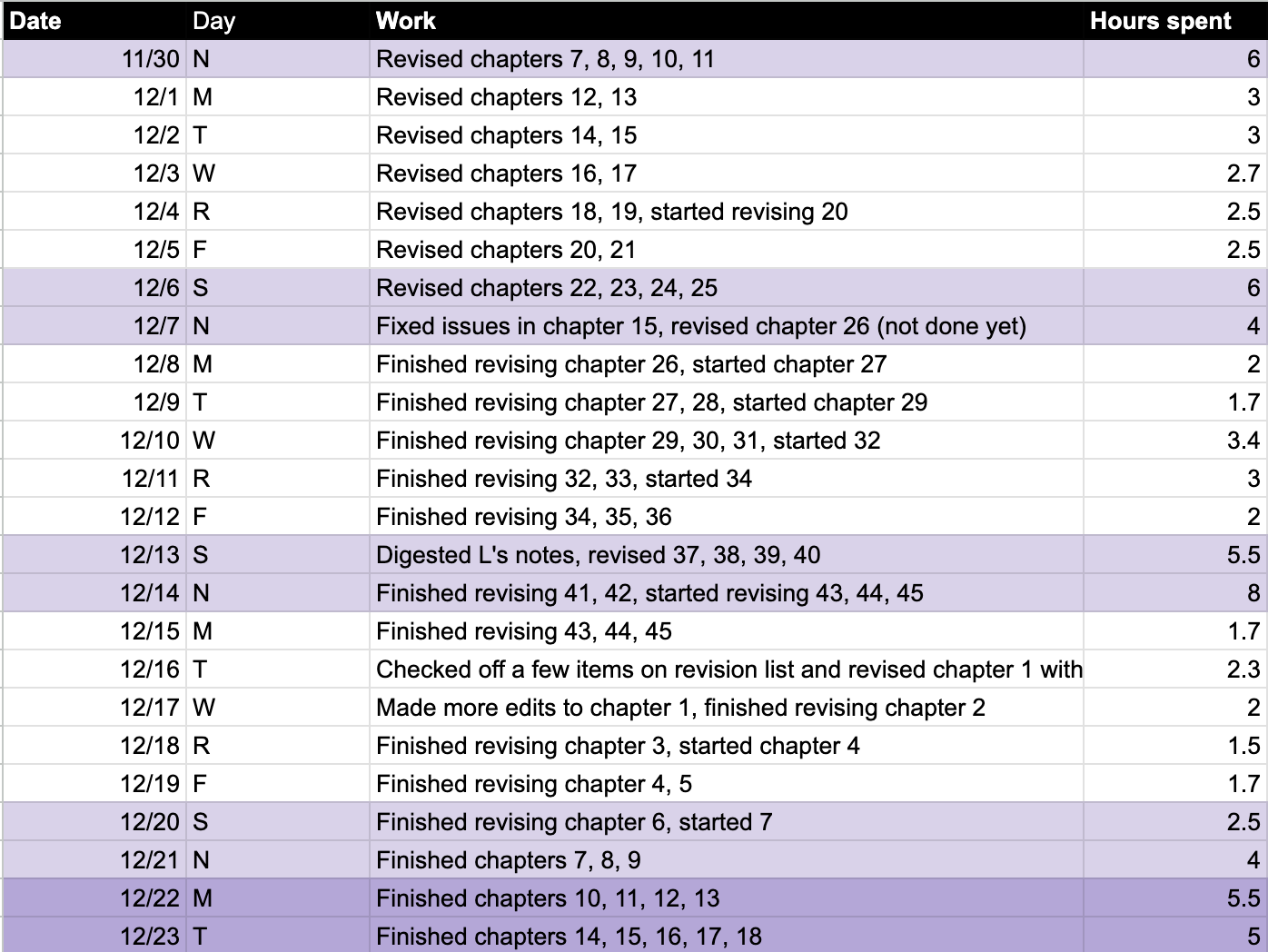
For much of 2025, I felt like I was spending a lot of time on the novel, but I couldn’t tell if I was actually making progress. There was always so much more to do, and I often found myself going back to previous chapters to fix new issues. It felt like I was sprinting really hard and not getting anywhere. I took inspiration from Delia Cai’s revision tracker and created a progress log of what I did each day and how many hours I spent on it. Seeing this documented alleviated the fear that I was on a doomed Sisyphean mission. I will be doing this with future projects and recommend it to anyone suffering from “circular momentum” syndrome.
To make time for writing, I had to say no to things (of course). I have a demanding full-time job, and I would never sacrifice my health or relationships. Reading is also non-negotiable (reading is to writing as nutrients are to the body). So what gives? While I enjoy the serendipity of the occasional large social gathering, meeting new people just wasn’t a priority, so I went out to fewer parties. I also decided to get off Substack, Twitter, and TikTok, and limit my Instagram use.
I’ve always been more drawn to content that requires sustained attention. Getting immersed in a good book or a well-written essay feels more nourishing than scrolling through a noisy, high-velocity information feed. But it wasn’t until I removed those distractions that I was able to get in touch with this desire and honor it.
There are things I do miss, though. In the past, I used my Twitter account like a test lab for incubating new ideas about dating, relationships, and creative work. Sometimes, a tweet would spark a whole essay. I also met some of my favorite people on Twitter. At its best, it’s an intellectual playground where curious internet citizens share funny, earnest, astute, and sometimes, delightfully unserious observations about the world. Unfortunately, these platforms do not reward the right incentives. A better Twitter, I think, would make likes, retweets, and follower counts private so they don’t become the metrics of validation that drive behavior.
I found myself falling prey to the algorithm. Every now and then, one of my tweets would go viral, and I’d gain a couple hundred followers in a day. The dopamine hit would prompt my brain to come up with tweets in anticipation of getting more likes and retweets. I felt rewarded seeing my follower count climb, but these were vanity metrics, shallow connections, and I didn’t like what it was doing to my brain chemistry. When I stepped away, I felt like I was detoxing from bingeing on sugary snacks.
Quitting Twitter wasn’t easy. As someone who’s motivated by success, I felt guilty for “giving up,” like I was missing out on an opportunity to build an online presence, something every writer knows is to be desired. I worried I was letting people down by not offering “fresh insights.” That’s the curse of success: even a small amount of it can drive us to keep building on the momentum without asking if the gains are worth the cost, if that’s what we want to be spending our time and energy doing. There may be a season when I’ll want to focus on content creation, but now is not it.
Intention is my theme word for 2026. I want to do things with purpose while letting go of expectations. I used to live in hard mode by taking on a lot of expectations (get into a top-tier college, get a prestigious job offer, get promoted every two years, have a child before 35, etc.) or setting arbitrary goals like I must publish a Substack post every week or I need to tweet something interesting every day. There’s a crucial difference between an expectation and an intention. I intended to finish my novel by the end of 2025, and I put in the effort, but I did not force the outcome. If it takes a few more days or a month or a year, so be it. Living a life guided by intentions allows me to follow my energy while making space for the unexpected.
ahhhh congrats elaine!! yesss time to celebrate ❤️ manifesting an abundant 2026 in trad pub land!
CONGRATS!!