

desire
the uncanny valley of dating

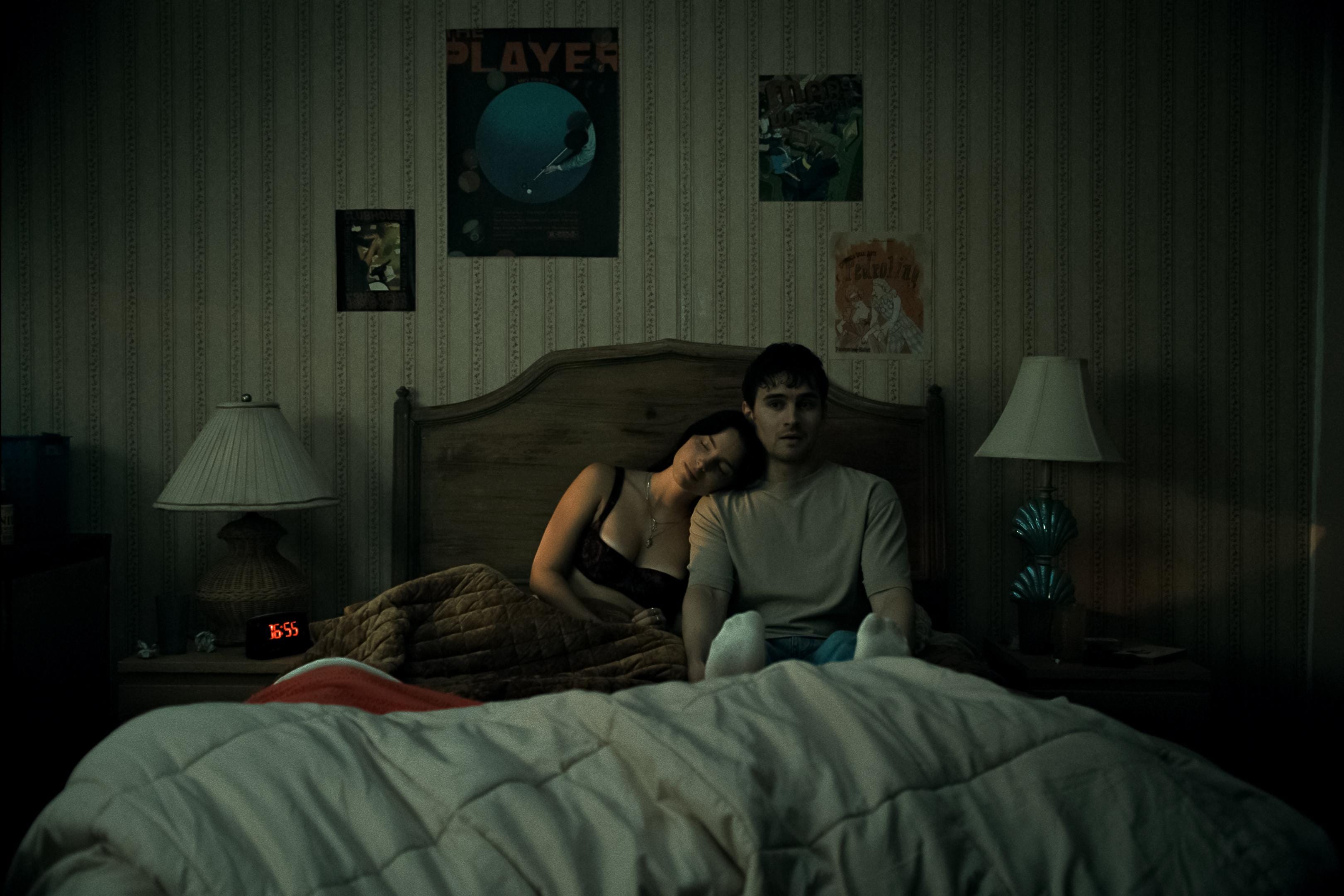
Warning: Spoilers for the movie ahead.
When I heard that the sleeper hit Obsession plays on the idea that dating and relationships can be “scary and anxiety-provoking at a very deep level,” I ran to my local theater. (You know you’re old when you get your pop culture news from The New York Times.) My novel that’s out on submission explores some of the darker themes of dating and attachment, so I was hungry for any discourse on the subject.
While the movie didn’t offer any groundbreaking revelations, it did give audiences plenty to talk about. Filmmaker Curry Barker says in a Nerdist interview:
I mean, I feel like I can be scrolling on my phone at night and I can see many scary things and not be affected at all. Then you just come across this one thing that you’re scrolling and it scares the hell out of you. It’s usually a person saying something really weird and their face is just slightly off and then you’re like, ‘Oh my God.’ And you have to turn the lights on. That’s the type of feeling that I wanted to capture so bad is this it’s human but it’s not quite human. A jump scare doesn’t get me anymore.
Masahiro Mori coined the term “Uncanny Valley” in the context of robotics to describe something that so closely resembles a human but isn’t quite human that it imprints on our brains as eerie and disturbing. It’s particularly applicable, I think, to modern dating, which is rife with psychological danger. You’re trying to ascertain the character and motivations of a stranger who’s putting on their best performance for your benefit. And when attraction and attachment enter the picture, even the most astute observer is susceptible to manipulation. (Belle Burden’s bestselling memoir is a reminder that we can find ourselves waking up next to a stranger even after twenty years of marriage.)
When we start dating someone, we’re trying to understand what kind of person they are. We’re implicitly trying to answer the question: Are they a good person? Our brain is categorizing them into familiar boxes based on their appearance, words, mannerisms, and behavior. A date can be going really well until something slips, a “glitch” that eschews categorization, a blip of inconsistency that suggests maybe they’re not who I thought they were.
Obsession is not exactly subtle in this regard. Nikki is unequivocally “wrong” the moment she reappears in the car window after Bear makes his wish. We don’t need any CGI or special effects to tell us this. We know that love can’t be coerced, so our brain registers her sudden transformation as unnatural before she starts taping doors shut and feeding Bear his dead cat.
The most disturbing dialogue in the film is when real Nikki, who is aware that her body has been commandeered by a demonic force, asks Bear to kill her, and his response is “What’s so bad about being with me?” His response struck me as so jarring and incongruous—a veritable “uncanny valley” moment—that my brain tried to erase it from my memory. The only conclusion I can draw is that the mask has slipped, and he’s revealed himself to be a selfish and oblivious brute. It’s like he has no conception that enslaving another person is wrong.
As a teenager, I used to think romantic persistence was hot. Persistence that tells you in no uncertain terms what a person wants is attractive, something Bear could not bring himself to do out of fear of rejection. But persistence that ignores another person’s agency is creepy. It stems from a long tradition that celebrates male domination and female subjugation. A respectable woman, it was believed in the Victorian era, could not truly know her own desires.
It sounds painfully obvious to say that to love someone is to respect their autonomy completely, but the temptation is always in us to fuse our desires with the person we love. What the movie grotesquely illuminates is how something we’ve probably all wished for at one point—pining over a crush or heartbroken over a breakup—is not the thing we actually want, and in fact, would be an utter violation of nature.
There’s a fine line between seduction and manipulation. Seduction works because the other person wants what’s being offered. Their innate desire has been activated. Manipulation, on the other hand, undermines their autonomy. They’re being forced to think or act a certain way, irrespective of their will. In Liquid Love, sociologist Zygmunt Bauman argues that desire is distinct from, and almost oppositional to, love. He describes desire as “the wish to consume”—even to “annihilate”—and love as “the wish to care and to preserve the object of the care.”
I think the movie would’ve been more aptly titled Possession. It’s not a story about infatuation and limerence so much as it is about mistaking a desire for ownership and control as love. For a good portion of the movie, I was convinced that Bear’s cat had been reincarnated in the body of Nikki. In wishing for Nikki to love him “more than anyone in the world,” what Bear actually wants is blind devotion and total dependence, not unlike a pet to her “owner.”
In the final scene, we’re led to believe that Entity Nikki used the willow to make Bear love her back equally. When he walks out of that bathroom with hearts in his eyes, I thought to myself, wow, that’s one way to resolve it. Get them on the same page, even if the same page means entrapment in a mutually coercive fantasy. If the movie ended there, it would’ve implied that the problem with romantic love is its asymmetry: one person will always feel “less loved” than the other.
But of course, the movie isn’t going to let either character off the hook. When the real Nikki comes back into herself and screams, it’s like she—and all of us in the theater—have just woken up from a really bad trip.
The party is over, and there are dead bodies.