

slow noticing
readers experience the world differently

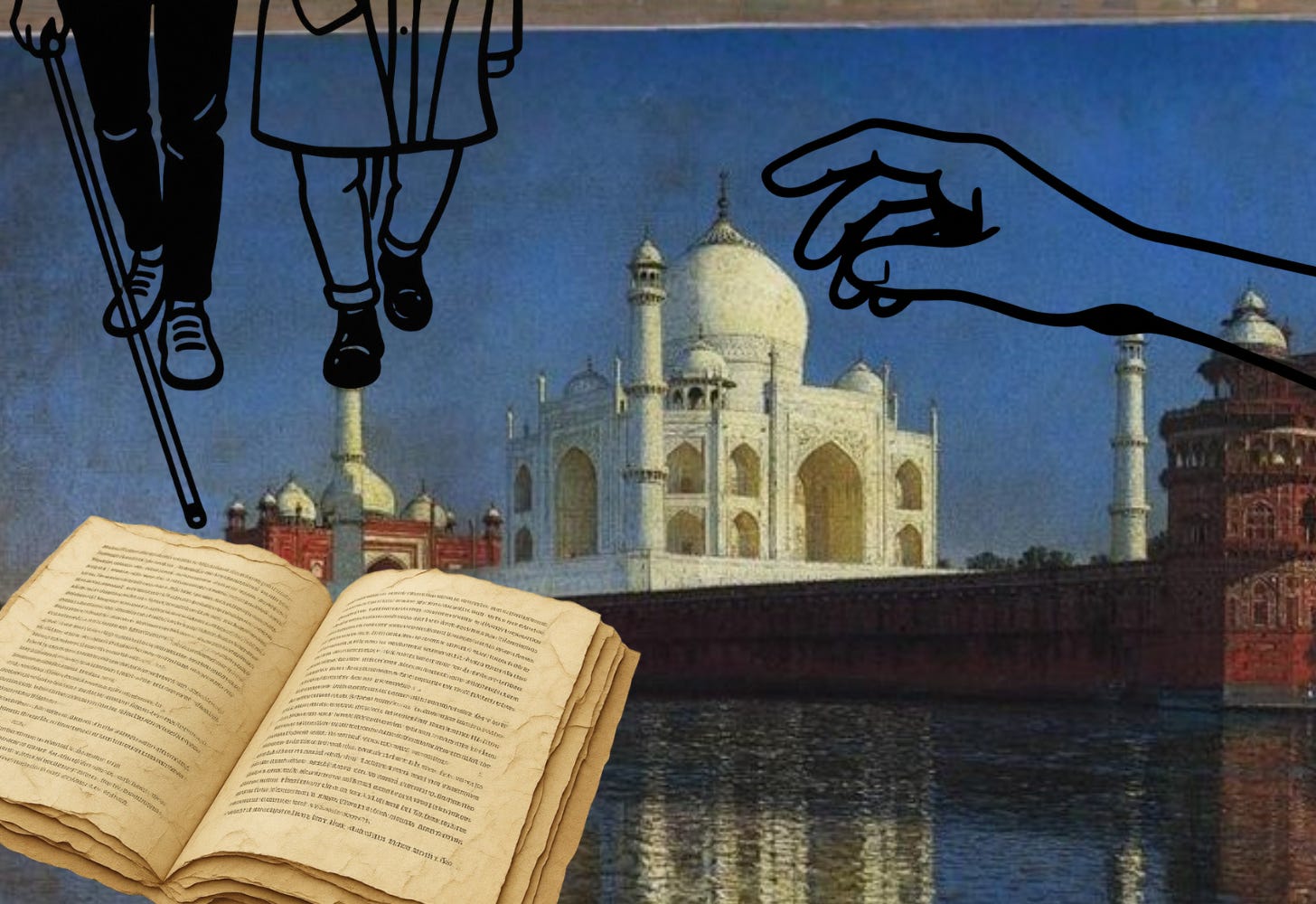
In last week’s episode of The Sunday Daily podcast, photographer and writer Andy Isaacson talks about traveling in India with a company that pairs visually impaired travelers with sighted travelers as companions. Isaacson finds himself describing “quietly prosaic” details to his blind companion Daniel that he otherwise wouldn’t have noticed:
The black and white painted curbs. The way that roadside vendors displayed their potato chip bags over the front of their stands like colored beads. The neat lane lines that were universally ignored. It was sharpening my noticing. And as I was describing these visual details, I was gaining a more vivid impression of India.
They visit the Taj Mahal, and Daniel picks up on the sound of someone running around “with bells,” which turns out to be a child wearing ankle bangles. He notices, too, that the acoustics of the tomb’s inner chamber amplify the tourists’ voices into a chorus—details that you or I might overlook.
For the sighted, traveling is like watching a film, but for the blind, it’s more like reading a book, and the book version is always better than the movie, says the founder of Traveleyes, Amar Latif. “It’s a more interpretive process in which descriptions feed imagination. The world reveals itself more slowly through these layers of sound and touch and scent.” If traveling for the blind is like reading a book, then for the sighted person guiding them, it’s like writing. What Isaacson is doing for Daniel is essentially worldbuilding.
His second companion is a woman named Candie who is more interested in the people inhabiting a place, what she calls “the reality of India.” She describes stepping off a bus, and a child coming up and patting her leg.
A sighted person might withdraw, but not knowing who or what has touched her, Candie reaches out and touches back, similar to how a kid learns about her world tactilely. Her surprise at finding a child’s rough hand (kids normally have smooth hands) leads her to imagine what kind of life the child must’ve had. Paradoxically, when we rely too much on our vision, we risk closing ourselves off and noticing less.
I was reminded of Raymond Carver’s iconic short story “Cathedral.” The narrator is insular, bigoted. He reluctantly plays host to his wife’s longtime friend, a blind man named Robert. The two have very little in common. Their conversation is stilted. They drink a lot of whiskey and smoke a lot of weed while the TV plays a program about the history of cathedrals in Europe. The narrator tries to explain what a cathedral looks like, but he’s terrible at it, so Robert asks him to draw one instead. As he draws, Robert holds the narrator’s hand while it moves across the paper in an attempt to “see” through the narrator’s eyes, a bit like Daniel and Candie being guided by Isaacson’s detailed descriptions, except in this case, they abandon words in favor of the tactile.
Robert then asks the narrator to close his eyes while drawing, essentially inviting him to step into his shoes. It’s no coincidence that it’s a place of worship they are creating (cathedrals were built in an attempt to reach God). When the drawing is completed, Robert asks the narrator to open his eyes, but he keeps them closed as if to prolong the transcendent state he’s in. Sometimes, we need to abandon the conventional tools of language and sight in order to see beyond the boundaries of our limited worldview, the story seems to say (though you could also argue they were both just drunk and high).
The best conversations are ones where everyone is building the cathedral together, so to speak. Everyone is a co-author of meaning. Disagreement is generative because each person is open to seeing “beyond.” Bad conversations tend to be one-sided or shallow. All bickering, on one extreme, or all polite agreement, on the other, both signal a lack of openness and trust.
I agree with Latif that the book version is (almost always) better than the movie. It got me thinking: what does it mean to live your life as you would read a book rather than watch a movie? I think it involves some amount of active engagement with your community and environment, slowing down so you can notice more, walking in someone else’s shoes (so important), being willing to go beyond surface-level interactions, challenging and revising your assumptions.
I love Sean DeLeone’s analogy: “If writing is talking, then reading is listening.” You can’t write if you don’t read. Fiction, in particular, opens us up to other ways of being and seeing because it activates our imagination and gives us access to another person’s consciousness. You can’t get that by watching a movie. Even in the most intimate heart-to-hearts, parts of a person’s interiority will always be hidden. What makes the act of reading transcendent is that it allows us to inhabit another person’s psyche, to see what they choose to reveal to the world and what they withhold—to find ourselves in that tension and vulnerability. Like traveling, when we return home from a good book, we see the world a little differently.
What I’m enjoying
In the spirit of reading, here are three books I’ve thoroughly enjoyed this year:
Kin by Tayari Jones: Heart-wrenching. You get invested in these two young women who are shaped by the same void in their lives (their mother) but whose choices take them on vastly different journeys, yet their friendship never wavers. It’s beautifully written, and the emotional payoff is well worth the slow build.
London Falling by Patrick Radden Keefe: This is nonfiction/true crime, but it’s written like the best fiction with immersive worldbuilding and shadowy, crazy-ass characters with complex backstories. It’s about ambition, class, and chasing fantasies of grandeur. It’s my first PRK, and I’ll be reading more of him.
Lost Lambs by Madeline Cash: This book enchanted me with its wit and wry humor (the verbal pyrotechnics are dazzling) and kept me reading because each person in the Flynn family—and their travails—is rendered with such warmth and humanity.

I love how, by speaking to the blind, we eliminate our own blindness. the cathedral is unchanged, after all.